



And my old friends, we were so different then
Before your war against the suburbs began
Before it beganAnd now the music divides
Us into tribes
You grew your hair so I grew mine
They said the past won’t rest
Until we jump the fence and leave it behind.— Arcade Fire, “Suburban War”
Springsteen-like “indie rock” ingenues the Arcade Fire released The Suburbs last year to great fanfare. Win Butler and crew looked past easy generalizations, suggesting that the suburban experience is more complicated than it has been given credit. As Pitchfork noted approvingly The Suburbs proved “a generously paced collection of meditations on familial responsibility, private disappointments, and fleeting youth, much of which takes place in moving vehicles.” The struggles of suburbia provided the group with material rich enough for a Grammy award winning album (followed by confusion – and anger sometimes – over who the band is), but far more importantly a powerful distillation of Arcade Fire’s considerable skills. People make place, not the other way around. However, as critics like J. Eric Oliver have pointed out, suburbanization has shifted populations into mono racial/economic communities in which citizens remain unengaged. Importantly, Oliver notes, “most of us are unclear about what exactly a ‘suburb’ is.” Most are located within metropolitan regions but outside the central city, but what if your metropolis lacks a true “central city”? How does urban suburbanization, so common in western and Sunbelt cities, shape human geographies?
Photo Essay: A Day in the Life of San Diego
Few American cities embraced suburbanized urbanization to the extent that San Diego, California has. The city’s growth remains an encapsulation of sunbelt surburbanization as five lane highways, free market ideologies, New Right conservatism and automobile dependency came to define the city. Municipal policies favoring private market housing have resulted in highly segregated city where much of the city’s white population resides in suburban townships – most of which oddly still count as part of the city – while its lower income residents reside in an ill defined part of the metropolis known as Southeast San Diego. In 1980, nearly 76% of the city’s residents were white, and thirty years later this trend has only intensified, increasing to nearly 80% by 2010. As a 1981 San Diego Union Tribune article noted, despite a battery of state, federal, and local housing programs, the metropolitan area’s pattern of segregation only deepened.
Boosters like Joel Kotkin hail San Diego’s neoliberal approach for its effectiveness in limiting the public sector (“Today San Diego has one of the lowest ratios of public employees per capita in the nation”) and unions (“In the early decades of the century, the city was famed for its hostility to the labor movement, a sentiment that sometimes spilled over into ugly anti-union vigilantism”), while pursuing what some refer to as the “San Diego Way”: privileging the private sector and personal initiative. For Kotkin, even minorities, which his article seems to suggest are to blame for urban political gridlock in other cities, (“The city lacks the politics of ethnic grievance that has entrenched a costly and divisive ethnic spoils system in so many older big cities”) have “committed to bourgeois respectability.” Kotkin admits San Diego has its “ghettos,” but the struggles of Southeastern San Diego Communities and the historic Logan Heights, home to Barrio Logan (a largely Mexican/Mexican American community home to famed Chicano Park), exist as an anomaly.

How was Kotkin to know that nearly all of San Diego’s net growth in the 1990s was going to be due to black, Latino, and Asian minorities? As Nancy McArdle points out, suburban growth has also been impacted by minority homeownership. However, despite this increase, McArdle notes segregation levels for Latinos, suburban and urban have increased. “It is especially disturbing, therefore, that the largest increases in overall segregation are for suburban Latinos,” she writes. “Indeed, while whites comprise 60 percent of the total suburban population, the average Latino suburbanite lives in a census tract that is just 45 percent white, down from 58 percent white in 1990. Latino/white segregation has also increased in the City, and is now on par with black/white levels.”
Writing in 1996, Kotkin either ignored these developments or was simply unaware. Instead, Kotkin focused on San Diego’s burgeoning urbanity resulting in a city with a “dash of urban excitement.” The popular demographer even suggests that newly constructed Gaslamp Quarter an area “once populated by drunks, homeless people, and sailors who couldn’t make it to the more extensive fleshpots of nearby Tijuana,” represented a West Coast “sun lit version” of New York’s Tribeca neighborhood.
Of course, anyone who heads downtown today will find the snazzy nightclubs, “authentic” pubs, and fancy hotel restaurants/bars Kotkin praises. Yet, they will also find a palpable homeless population, boutique hotels next to neon lit check cashing stores, and grubbiness that in spots rivals the very New York he disparages. Finally, though some of the Gaslamp Quarter shines, it does so in a very unrealistic way: a Disneyfied version of the Lower East Side, one might argue, with more homeless people. Moreover, this all ignores the fact that in terms of providing housing for its low income populations, the city’s hostility toward public housing resulted in less than 2000 public housing units total. When new pro market private-public schemes developed under the low income tax credit , the city had no infrastructure to take advantage of its vaunted “private sector.” Its resistance to public housing meant it never developed the institutions, connections, and housing knowledge to build even affordable housing. As a result the city relies heavily on section 8 vouchers providing over 14,000 families each month with subsidized housing. Still, there remains 5 -7 year wait for the thousands of families in line to qualify for the voucher. In 2002, the city council declared affordable housing in the area to be in a state of crisis. Kotkin’s 1996 article failed to note this development despite the fact city planning reports dating back to the 1970s pointed out that the metropolitan area lacked the adequate stock of low and middle income housing.
Still, Kotkin does get some things right. For example, he notes the explosion of college diplomas and advanced degrees. Between 1970 and 1990, San Diego absorbed over 300,000 people with college degrees rising from 96,000 in 1970 to nearly 400,000 in 1990. By 1996, over 25% of the city’s population held a BA, which at that time was about 5% over the national average. Additionally, San Diego exceeded all other cities in PhD per capita. Undoubtedly, the establishment of the University of California San Diego (1960) with its elder sibling San Diego State University (established in 1897 as the San Diego Normal School) have contributed to these developments (nor should the private University of San Diego be ignored).


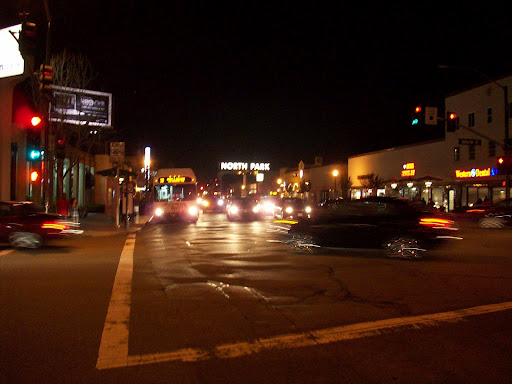
This creation of what Richard Florida would call a “creative class” drove neighborhood change in the Gaslamp Quarter and other areas. Formerly hardscrabble neighborhoods like Golden Hill, North Park, Hillcrest, University Heights, and to a far lesser extent Normal Heights were gentrified in part by these new educated classes but also by Southern California hipsters (sleeve tattoos are the new black and yes, lots of bicycles, no comment on fixies). Hillcrest came to be the dominant gay community (though all of these neighborhoods are very gay friendly). As Josh Sides has recently documented in Erotic City: Sexual Revolutions and the Making of Modern San Francisco, SF’s famed Castro district underwent a transformation in the 1970s as gay residents renovated the neighborhood’s run down “Victorians” and reshaped the city’s cultural geography. However, this process also drove gentrification such that at the end of the 1970s “the median value of a Castro home was 37% higher than city wide average.” (111)
In San Diego’s Hillcrest, night life centers around the University Avenue strip where one can find everything from dive bars (The Alibi – punky, highly recommended) to live venues (The Ruby Room– really cheap happy hour) to 1970s era lounges like Nunus (red lights and old fashioneds) to the more stylistic grace of the Tractor Room (fancy mixed drinks and a farming motif refracted through 21st century hipsterdom).


Still, there are other ramifications from this presence that many find less than attractive. First, disability in San Diego remains a relatively common experience. In addition to veterans from previous wars ranging from Vietnam to the first Gulf excursion, numerous soldiers return from combat in Afghanistan and Iraq with injuries that leave them physically challenged on some level – to make no mention of mental wounds. Second, the burgeoning “Asian massage” industry, one that may or may not hinge on human rights violations, has proliferated. While one may find terrific Vietnamese food on El Cajon Avenue, residents may also indulge their more prurient desires either through the numerous massage parlors or the shifting prostitution scene in the same area. Certainly, the military is not wholly to blame, but segments of its large numbers of unattached male service personnel probably dabble now and then in the darker side of the city’s nightlife.

Ryan Reft