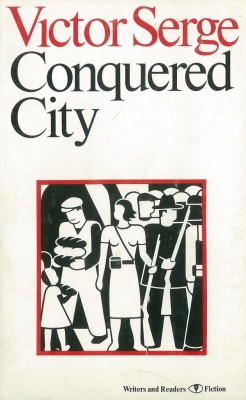
Following on from my previous posts, one of the most striking features of Victor Serge’s writings has to be the way he captures spatial arbiters that shape the practices of empowerment and containment within the territorial form of the city. Flowing across his documentary or witness novels, his political writings, his poetry, or his memoirs as a revolutionary is a sense of the political processes shaping urban society, the space of the city, and the possibilities of revolution rising up from the streets. Nowhere is this more evident that in his novel Conquered City [1932] set in the years of the Russian Civil War (1919-1921) in the frontline city of Red Petrograd. Written just prior to his years of captivity in Soviet Russia at the hands of Stalin’s purges­­­­­­­­­­­­ (from imprisonment in the Lubianka to exile in Orenburg on the Ural River) and completed in concise fragments that could be despatched abroad hastily, Conquered City is a masterwork on the conquest of space.

Recently, in a blog post entitled “Monumentalising Revolution,” my commentary argued that the Monument to the Revolution in Mexico City stands as an ambiguous carrier of utopian promise, which links past and present generations of struggle. Specifically, my concluding point was that this architectural space stands as a possible symbol of “the effective participation of the present generation in shaping the utopian desires of the oppressed, linked to ongoing past and present social struggles.” Written in April, there was no anticipation in this piece of the events to come that have swirled around the student movement #YoSoy132 in contesting the presidential election process in Mexico.

“With great privilege comes great responsibility.” So says the corrupt old tortoise who runs the town of Dirt […]

In 1974 an autoworker from Michigan named Dewey Burton remarked disconsolately to a reporter, “I wanted to be […]

We want tweets With the emergence of a diverse and spontaneous popular movement in Egypt, it is a […]

It has been ten years since Michael Hardt, a literature professor at Duke, and Antonio Negri, an imprisoned […]