
We must cultivate our garden.
— Voltaire, Candide (1759)
This is my seventh year at the community garden, and until this year I had been just a regular Joe, tending my own 7-by-10-foot plot. My biggest concerns were root-knot nematodes (tiny parasitic worms that can wilt healthy tomato plants overnight), squash vine borers (as bad as they sound), and vandalizing squirrels (if only I could put their little furry heads on a pike to send a message).
I have since pivoted from vegetables to more flowers, but a different set of problems has taken hold. In general, the commissars who run the Park and Recreation Department’s community garden have been apathetic. They have little or no experience or interest in gardening. To be fair, these administrators often have more demanding responsibilities—pool management, scheduling sports leagues, or filling out accident reports on senior-citizen pickleball.
Their apathy is sometimes interrupted by a strict adherence to outdated rules, which they refuse to change without sending the matter through the city’s legal gauntlet.
On the other side of the spectrum are the allotment gardeners, who hold conflicting views about what organic gardening should be. Some want their plots to be palatial: free of weeds, arranged in neat rows, and in full compliance with the rules. Others prefer no planning, no weeding, and a philosophy of letting nature take its course. They maintain that all plants have consciousness and are sentient. When their plants grow beyond the raised beds, they are simply exercising free will.
These opposing philosophies often butt up against each other in the garden—and inside my own head. So much for gardening as a leisure activity.
Historical Precedence
After reading Kate Brown’s Tiny Gardens Everywhere: The Past, Present and Future of the Self-Provisioning City (2026), I came to understand that the relationship between community gardeners and those who manage them is not always as bucolic as we might like to believe.
A professor of the history of science at MIT, Brown explores the role working-class gardeners have played throughout the world over the past couple of centuries. Her chapters include the dung community in England, shantytown gardens outside the medieval walls of Berlin, and the food grown by the Black community of the Great Migration in Washington, D.C., during the Depression. Brown describes how people in Soviet-bloc countries—including Estonia, Poland, and East Germany—battled authorities to grow enough of their own food to stave off bureaucratically created starvation.
The book also includes Brown’s own experiences gardening in Washington, D.C., and the personal battles she has had with city planners, developers, and her neighbors.
There is, however, a self-righteous tone to the book. To Brown, gardeners are beyond reproach and should be allowed to grow whatever suits them, even when their gardens encroach on spaces they do not own. Meanwhile, administrators become pawns of wealthy landowners, with an unspoken directive to remind community gardeners that they are only renters and must remain under the soil-compacting boot heel of the commissars.

Managing Disobedience
At my community garden, our garden-variety commissar administers registrations, collects fees, and controls who gets a plot and where it is located: full sun, partial sun, or the stinky plot near the compost bins.
At signup, each gardener receives a list of 50 guidelines to sign off on. Because these directives have not been rewritten or modified in years, they sometimes conflict with current de facto practices.
One of the more controversial rules is: “Do not grow invasive or nuisance plants (i.e., morning glories, bamboo, trumpet vines, hops, honeysuckle, etc.).” “Etc.” is a major gray area because of its carte blanche interpretation. One person’s nuisance may be another person’s childhood memory.(Note 1)
The word “invasive” is also fraught with dubious meaning, given the current climate toward immigration. Some gardeners, however, are very fond of their plants and will defend their rights—willing to chain themselves to an English ivy, even though that is a plant that practically smacks of colonialism.
Another sore spot in allotment gardens is what happens when plots are left unattended. All gardens are beds of optimism in the spring, but a health issue—usually a loss of heart or motivation—or a tender’s long vacation can keep even the best-intentioned gardener away from a plot for weeks. This allows relentless weeds to turn it into a “neglected plot,” which, according to the rules, can be forfeited and assigned to someone else.
Historically, in our community garden, that rule is rarely enforced. For slackers who don’t think their plots should have to look like the Garden of Versailles, this is a good thing. For other gardeners who are dealing with their neighbors’ encroaching plants and spreading weeds, however, it creates tension—a micro-range war, if you will.
Rogue Justice
At our garden, sporadic enforcement is carried out by a group known only to themselves as the Friends of the Community Compost Pile (FCCP).
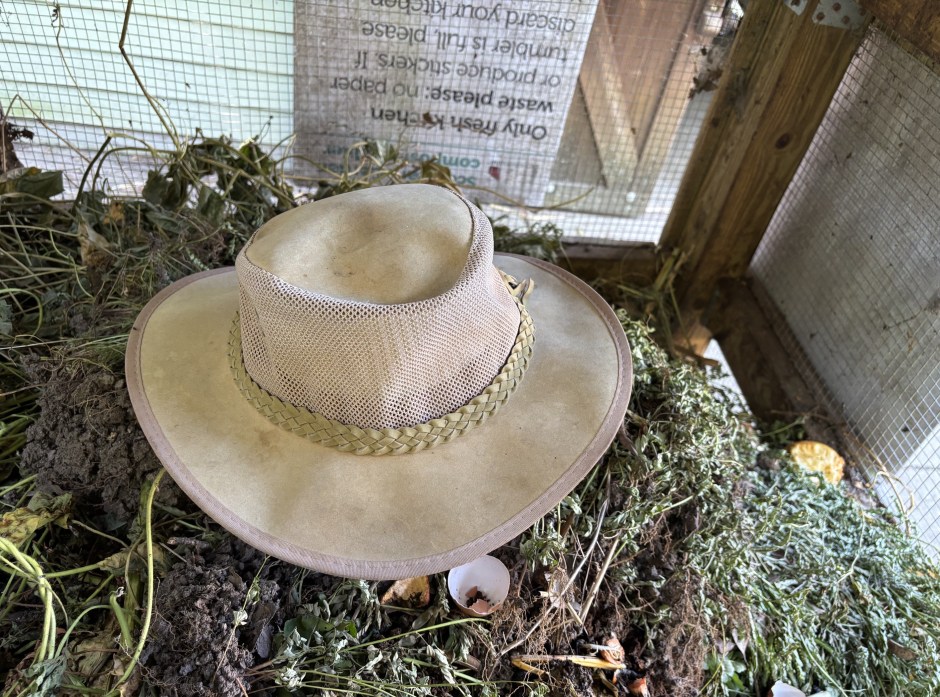
This group originated several years ago when a small band of gardeners, supported by a community grant, built a trio of industrial-sized compost bins. They took pride in their accomplishment, but it did not end there. They established guidelines for what could be added—rinds, coffee grounds, and leaves—and what could not: meat scraps, diseased plants, and dog shit. They then attached combination locks to keep out intruders.
They also took on the mucky job of periodically turning the compost—mosquitoes, fire ants, maggots, and the smell of rotting fruits and vegetables notwithstanding. They expected the compost rules to be followed. They even had their own pitchforks to back them up.
But their responsibilities began to spill over into other areas of community-garden maintenance.
Recently, at a garden workday, and with a nod from the commissar, the FCCP descended upon a double plot overgrown with bean plants and morning glories. Armed with hedge clippers, loppers, and sling blades (gas-powered weed whackers are not allowed inside the fenced perimeter), these kapos took the jungle down to the ground with great zeal. Let this be an example to others willing to flout the rules.
In short, there is a steady crop of disobedience and dissent at our community garden, and I assume in other community gardens as well. This would seem to contradict the rose-colored-glasses view of Brown’s book.
While I am tempted to say, “It is what it is,” I felt that was a cop-out. I needed a better understanding of my own ambivalence about community gardening, so I turned to another writer who understands both totalitarianism—or, in our case, a mild form of authoritarianism exhibited by the commissars—and gardening: George Orwell (1903–1950).
Orwell’s Roses
We think of Orwell as the Nineteen Eighty-Four (1949) guy or the writer who fought in the Spanish Civil War in Homage to Catalonia (1938). But he was quite a gardener as well—an almost off-the-grid kind of guy who raised pigs and sold produce and supplies at a general store in Hertfordshire near London with his first wife while writing and fighting tuberculosis. (Note 2)
He would use his rural experiences to write Animal Farm (1945), a short dystopian, anthropomorphic fable in which the pigs overthrow the human rulers of Manor Farm, only to become authoritarians themselves. It was intended as a satire of the Soviet Union and a shortcut for tenth-grade English students assigned to read a classic novel by the end of the term.

It is this gardening aspect of Orwell that drove the prolific author Rebecca Solnit to make a quixotic pilgrimage to Hertfordshire. Solnit was hoping to find the fruit trees that Orwell mentioned in one of his essays. Instead, she found only stumps and some roses, which, according to local accounts, Orwell had mentioned in a 1939 diary entry.
This was the launch point for her book Orwell’s Roses (2021). Solnit writes:
They were roses, and they were saboteurs of my own long acceptance of a conventional version of Orwell and invitations to dig deeper. They were questions about who he was and who we were and where pleasure and beauty and hours with no quantifiable, practical result, fit into the life of someone, perhaps of anyone, who also cared about justice and truth and human rights and how to change the world. (p. 14)
Solnit also uses this lens to examine Winston Smith, the protagonist of Nineteen Eighty-Four, whose only recourse to fight the Ministry of Truth was not through futile resistance but through “thoughts and acts that violate its precepts.” Solnit explains:
So Smith works at having an interior life with memories, thoughts, emotions, reason, independent-mindedness, true solitude, and true connection. And at establishing evidence of an objective reality to which he wishes to swear a kind of loyalty because he is forever trying to piece together a reliable sense of the past, even though his job at the Ministry of Truth is to alter it. He desires the life of the mind and the senses, and beauty, and history, nature, pleasure, and sex, and the privacy of freedom in which all those things flourish. (p. 252)
In the penultimate chapter of the book, Solnit offers a parable that briefly struck a hopeful chord for an ambivalent gardener like myself. She writes:
“The Buddhist parable about the person who, having fallen over a cliff while being chased by a tiger, grasps a strawberry plant that is coming loose, and whose death in a fall is inevitable, advises savoring the strawberry. Orwell seemed to be doing that with his new life in Jura; (Note 3) Winston Smith did that with his pursuit of pleasures and liberties.” (p. 253)
My interpretation of these two sentences is that the value of gardening goes beyond the harvest or keeping score about who has the best tomatoes or broccoli.
Solnit recognizes that the beauty of the garden lies in allowing one to be in the moment. Planting a seed at the right depth and soil temperature or transplanting a seedling requires concentration. This can offer a respite from the daily idiocy that surrounds us.
But for me, that isn’t enough. I don’t necessarily focus when I am down on my hands and knees in the soil—my mind wanders. So perhaps gardening provides something more.
Reading and Gardening
To understand how this wandering works, I revisited one of my favorite books, Witold Rybczynski’s Waiting for the Weekend (1991), which offers historical musings on leisure. Rybczynski writes:
Solitary reading is the ideal vehicle for individual leisure. The reader can do something or nothing. He sets the pace, reading uninterruptedly or leafing through a book at random, letting his imagination free to make what connections it will… Reflection, contemplation, privacy, and solitude are also associated with reading books. And withdrawal. Both withdrawal from the world around one, from the cares of everyday life and withdrawal from oneself. (p. 191)
Toward the end of the book, he explains the power of gardening:
Gardening is undertaken voluntarily, for one’s own amusement, and it fulfills Johan Huizinga’s (Note 4) three criteria for true play: it represents freedom, it stands outside everyday life, and it contains its own course and meaning (which, like that of most play, can be serious). But it’s a special kind of play. Unlike spectator sports, most games, and recreational pastimes such as dancing, gardening is not social—it is usually private. The gardener is a solitary figure, who, like the book reader, withdraws from the real world to one of his own creation. (p. 208)
This explains not only how gardening produces more than vegetables, but also how it generates ideas. Orwell wrote Nineteen Eighty-Four while living in Jura and gardening. Reading and gardening allow the mind to drift and make connections, albeit, in my case, wonky ones. My original title for this piece was “Navigating Totalitarianism and Dissent in the Community Garden.”
I will admit that I may have exaggerated the actions of my FCCP comrades and the transgressions of the commissars, but the ideas did come from reading these books and gardening. Fundamentally, I tried to stay within the spirit of truth and not the Ministry of Truth.
I fear that my comrades may not understand. Remember, they have access to pitchforks, hedge clippers, loppers, and sling blades—and they know the combination to the locks on the super-sized compost bins.
Sources & Credits
Brown, Kate. Tiny Gardens Everywhere: The Past, Present and Future of the Self-Provisioning City. W. W. Norton & Company, 2026.
Rybczynski, Witold. Waiting for the Weekend. Viking Penguin, 1991.
Solnit, Rebecca. Orwell’s Roses. Penguin Books, 2021. (Page numbers reflect the trade paperback edition)
Photo Credits: Murray Browne
Editorial Credits: Mark Burrell, Francis Walker, and Denise Casey.
Notes
1. I remember appreciating my grandmother’s morning glories while eating breakfast in the back room off the kitchen. It was the same room where my grandfather kept a rack of rifles that he used to shoot nuisance crows off the neighbor’s roof. Such a strong memory, huh?
2. To be clear, Solnit visited Orwell’s farm near Wallington, Hertfordshire, outside London. Orwell lived there with his new bride in 1936, left briefly for the Spanish Civil War, and after returning from Spain in 1937 remained there until 1940, when he moved to London.
3. This is a reference to the Isle of Jura, off the Hebrides in northern Great Britain. After World War II, Orwell lived in this rural and remote area, where he wrote Nineteen Eighty-Four.
4. Johan Huizinga (1878–1945) was a Dutch cultural historian and author of Homo Ludens (1938), a book about the importance of play in human culture.