
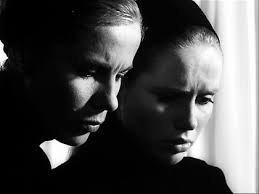
In my pretentious youth, I watched a lot of arty movies. The Shows to Go video store in Gastonia had a shockingly good assortment of foreign films, and when I got to college, I feasted on the old VHS tapes of Janus Films-type fare at the university library. Ingmar Bergman’s Persona became one of my favorites, which I unfortunately foisted on unsuspecting and very bored friends.
It was hard not to think of this icy lesbian classic when seeing Jane Shoenbrun’s Teenage Sex and Death at Camp Miasma. Like its predecessor, it basically has two characters, two women whose identities become intertwined. But while Bergman’s film was dark and brooding, Camp Miasma is completely bonkers.
The film follows Kris (Hannah Einbinder), a breakout indie whiz kid who gets hired to reanimate an old 80s film franchise, a la Halloween, Nightmare on Elm Street, or Friday the 13th. Since the original films had pretty heavily misogynistic and transphobic themes, the idea of recruiting a young queer ingenue to direct the remake is appealing to the vapid ghouls in Hollywood. Kris sets out to meet the star of the original film, Billie Presley (an incredible Gillian Anderson), who has become a recluse in the years since the heyday of schlock. Somehow, she has a manse on the campgrounds (basically Camp Crystal Lake) where the movies were filmed, whiling away the years in her memory palace.
It’s never entirely clear why Kris has to make this voyage — to see a one-hit wonder who hasn’t done anything since 1983 is supposed to inspire her to do what exactly? Clearly, she has motives that even she is not quite aware of.
It would do no good to spoil the plot because there really is not much of one. Billie is a cipher, in a way, a sounding board for Kris’s own desires and ambitions, albeit with a truly amazing Southern drawl. (When Kris tries to explain what “poly” means to Billie is one of the funniest moments of the film.). Throughout, the viewer assumes the other shoe is going to drop — Billie is an Anthony Perkins-style psychopath? Or is Little Death, the Jason/Freddy Krueger villain from the films, actually real? When is the big thing going to happen?
Schoenbrun expertly fakes and feints from scene to scene, never really allowing the viewer to achieve the, um… climax that we’re expecting. (Of course, “Little Death” is a wry allusion to the French expression for an orgasm, la petite mort.). LD is an old-school slasher with a giant metal head that looks like an HVAC vent, with inescapable sexual connotations. His (?) origin story is rooted in a kind of transphobic mythology — when Kris and Billie watch the first film together, Kris is like “This part is transphobic” and Billie deliciously just says, “Shut up.”
The conclusion of Camp Miasma is perhaps as vague and inscrutable as the end of Persona, though in this case the two women do not merge into one shared self. They go, blood-drenched, to a convenience store. If there is any criticism I could make, it’s that Schoenbrun is having way too much fun making this movie. Like watching a band perform live where you can tell the musicians are having a great time, it’s fun. Schoenbrun has the aesthetic ambitions of a Bergman or Godard, but their brain is beautifully addled by the pop culture garbage of the millennial experience, and they have a genuine sense of humor even as they explore deep and heady themes. I watched all the same idiotic sitcoms and movies they did in the 1980s and 1990s. Candies and treats are a constant motif in the film, as if Schoenbrun is saying, “Take it easy. Take a load off. It’s okay to have fun.” It is exciting to see a director who is willing to paint in candy colors on a canvas this big.

P.S. Fortuitously, I wore my Civic TV t-shirt to see the film, which includes a wonderful visual allusion to David Cronenberg’s 1983 classic Videodrome.